Nominal values
Enter the nominal values of the mains to be measured here. These nominal values are required for the measurement and calculation of measured values.
Settings
Note
* This setting is only available on measurement devices of the PQ-L series.
** This setting is only available on measurement devices of class S.
General nominal values
Nominal frequency
Automatic: The measurement device can determine the mains frequency automatically if a sufficiently high voltage is applied to voltage measurement input V1, meaning at least 20 Vrms for 4-wire measurement; at least 34 Vrms for 3-wire measurement.
If the measured voltage is not sufficiently high, the device cannot determine the mains frequency automatically and thus cannot measure it.
50 Hz/60 Hz: If the measurement device cannot determine the frequency (in the case of poor power quality, the sine wave of the voltage may be distorted to such an extent that double zero crossings occur, for example), you can set a fixed nominal frequency. If the frequency setting is fixed, the measurement device does not determine the actual frequency.
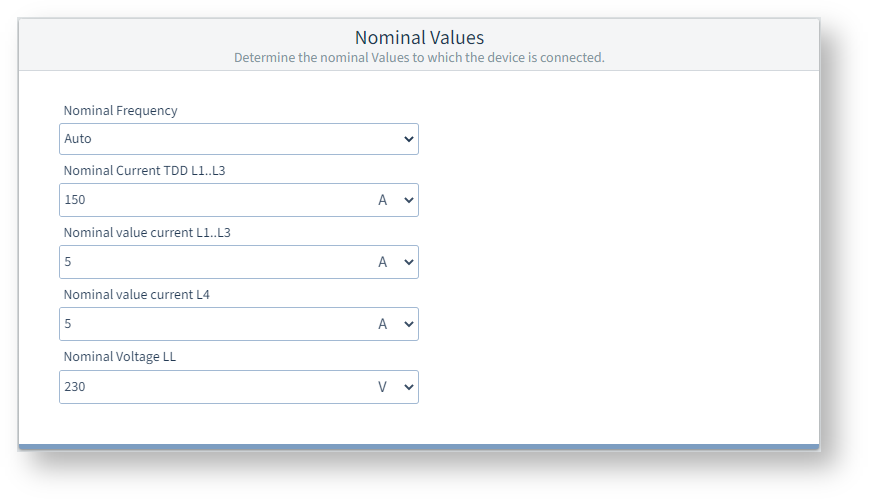
Example image: UMG 96-PQ-L
Nominal current TDD L1..L3
This is the same parameter that is set in the device under Configuration > Measurement > Nominal current.
TDD stands for Total Demand Distortion and is similar to THD (Total Harmonic Distortion). TDD is a characteristic parameter for the harmonic current distortions that occur in relation to the maximum current of the system that occurs. To be able to calculate this characteristic parameter, you must set the maximum current that occurs in the system here. The measurement interval for TDD is 15-30 min. The characteristic parameter TDD is widely used in North America, among other regions.
So while TDD refers to this fixed nominal current, THD is a dynamic characteristic for harmonic distortion in relation to the actual measured current.
Enter the maximum current that occurs in the system (nominal current under full load) in the input field and select the appropriate unit.
Nominal values for power quality
The following parameters are only needed to evaluate the power quality, which is why they are only available on PQ-L series measurement devices:
Nominal current L1..L3 *
This nominal current is used to determine the full-wave RMS values.
Enter a uniform nominal current for the 3 current measuring channels L1..L3.
Nominal current L4 *
This current measuring channel is available on measurement devices of the type UMG 96-PQ-L-LP or when using the 96-PA-RCM-EL module.
Enter the nominal current of the 4th current measuring channel in the input field and select the appropriate unit.
Nominal voltage LN or nominal voltage LL *
Enter the nominal voltage here. This setting depends on whether a three-wire or four-wire system is selected under Grid configuration.
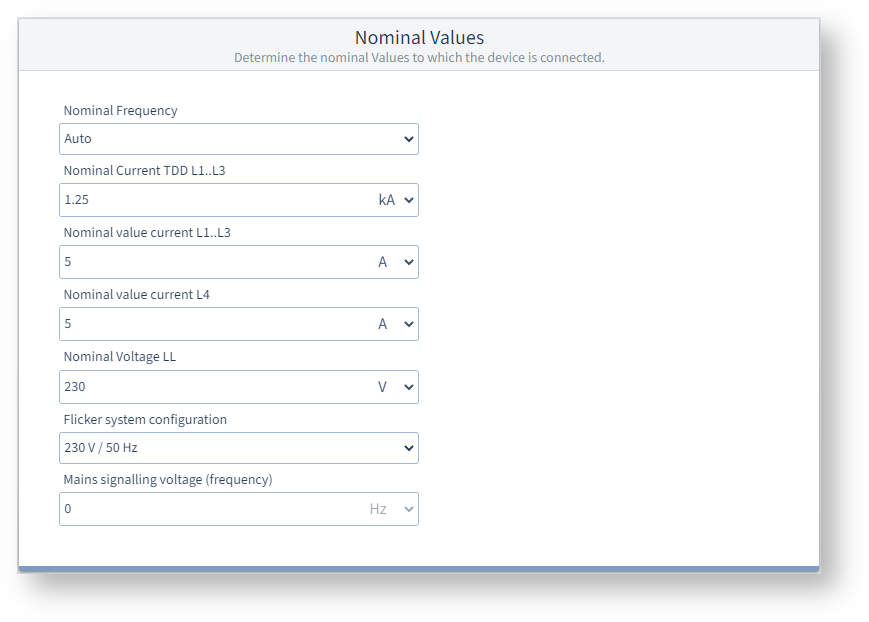
Example image: UMG 96-PQ-L with class S activation
Configuration of the flicker system **
A flicker is a brief fluctuation of the operating voltage, which, in the case of unregulated electric light sources (fluorescent tubes, incandescent lamps), leads to a visually perceptible fluctuation of the luminance . Flicker is caused, for example, by periodic load fluctuations of larger consumers and theassociated voltage drop on the lines.
The values available for selection come from the standard DIN EN 61000-4-15.
Enter the grid system that the measurement device is to use to configure the filters for the evaluation.
Mains signal voltage (frequency) **
Mains signal voltages are used, for example, to modulate ripple control signals for HT/LT switching.
Enter the frequency used for the mains signal voltage. The measurement device checks whether interharmonics are present at this frequency. Live values can be read out via Modbus.