Comparator
Comparators enable the monitoring of limit values. Several comparators in a comparator group can be logically linked (AND or OR operation). Depending on the result of the comparison, a digital output can be switched for a certain time, for example.
The number of available comparators and comparator groups depends on the measurement device:
PA series: 2 comparator groups with 3 comparators each
PQ-L series: 5 comparator groups with 10 comparators each, preset profiles
The configuration cards are adapted accordingly.
Settings
Note
* This setting is only available on measurement devices of the PQ-L series.
Profile selection *
You can select predefined comparators, e.g. Collective fault message, current (I MAX). More information is displayed in the tooltip when you move the mouse over the blue Info icon.
Apply
The selected profile only takes effect after the Apply button is pressed. The comparators of this comparator group are adjusted accordingly.
Comparator group name *
You can assign a short name to each group (max. 7 characters).
Comparator name
You can assign a short name to each comparator (max. 7 characters).
 Use the red minus symbol on the right to delete a comparator. To add a comparator, scroll down to the Add comparator button.
Measured value selection
Select a value from the drop-down list. Expand a branch and select an element from the lowest level, e.g. RMS current L1.
Mode
Select whether the comparator should react if the threshold value is exceeded or undershot.
Select Not used to temporarily disable a comparator without deleting it.
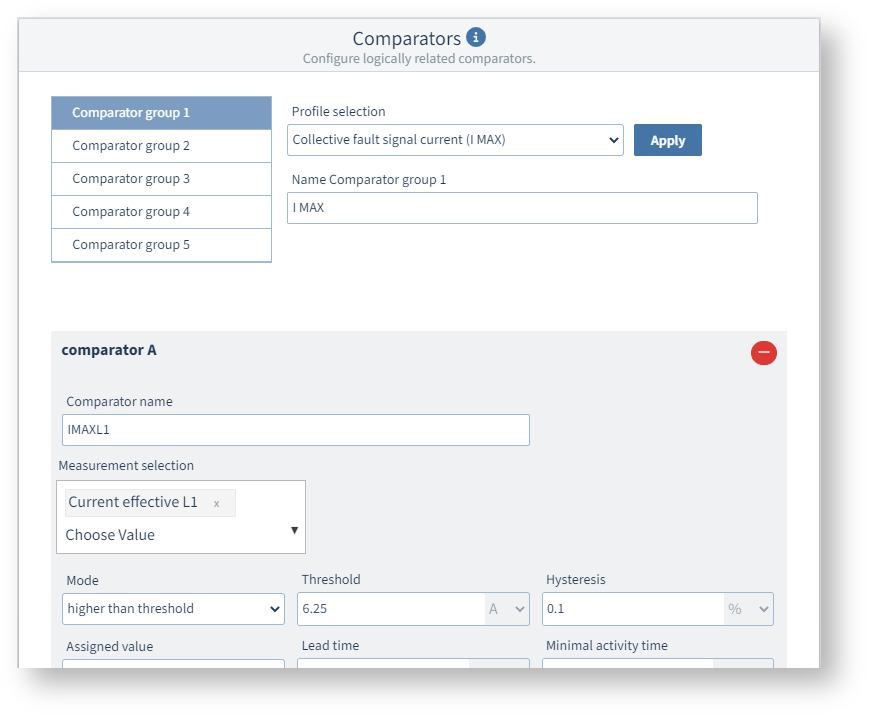
Example image: UMG 96-PQ-L
Threshold value
Specify the value for comparison in the unit of measurement used for the measured value.
Hysteresis
Use hysteresis if the comparator result is to return to the initial state with a delay time relative to the cause.
In the event of a limit value being exceeded – for example in the event of overcurrent or overvoltage – the following applies:
Without hysteresis (0%), the comparator result changes immediately as soon as the threshold value is undershot or exceeded again.
With hysteresis, the comparator result does not change until the threshold value plus the hysteresis is reached again (behavior of a two-point controller).
Assigned measured value
Select whether the current measured value, the average value, or the minimum or maximum value is to be compared with the threshold value. The average, minimum or maximum values refer to the associated time interval for voltage/current/power that you have defined under General > Sliding Average.
Lead time
Use a lead time if the comparator is to switch on with a time delay relative to the assigned measured value.
Minimum activity time
The comparator switches at least for the duration of the Minimum activity time.
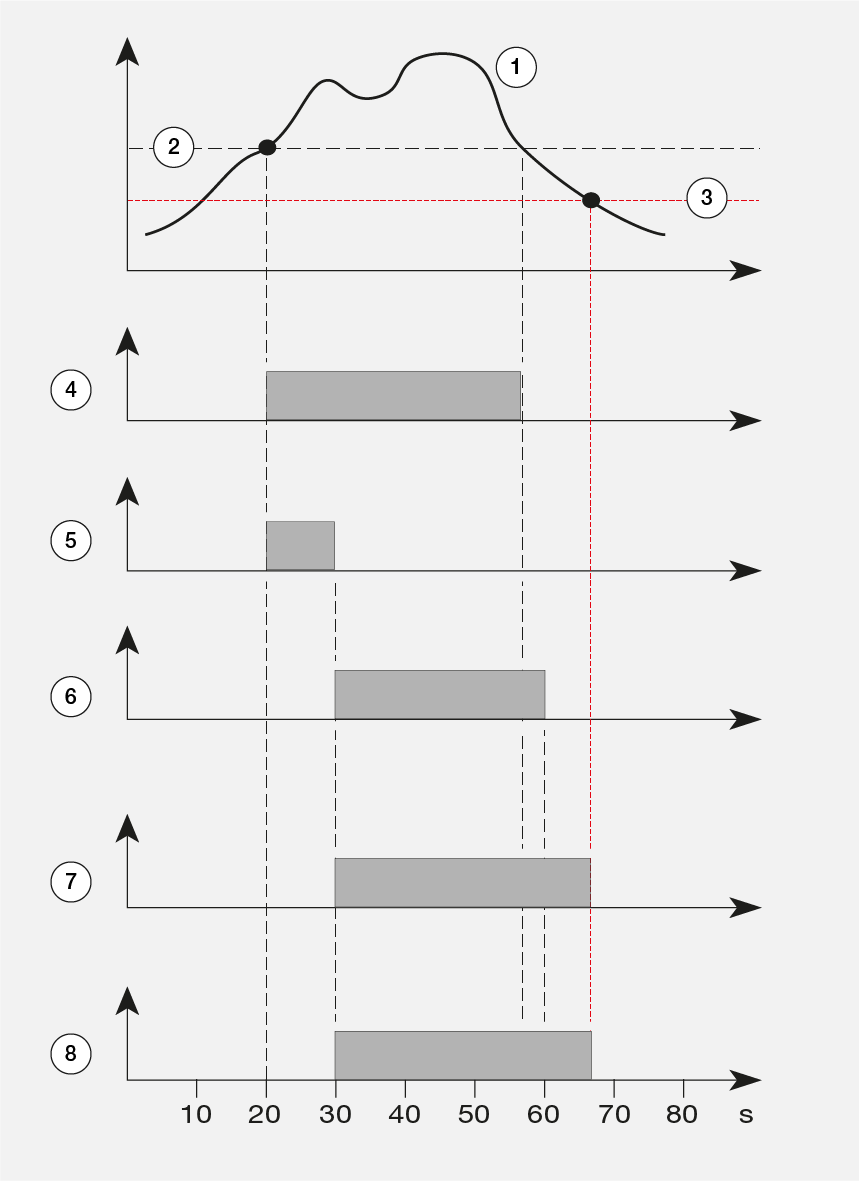
History of the assigned measured value
Threshold value
Hysteresis
Limit violation (exceeded)
Lead time
Minimum activity time
Comparator result
Comparator running time
Example image: Comparator with hysteresis. Example with 10 s lead time and 30 s minimum activity time